The Neolithic Age: Prehistoric Evidence from the Lalmai-Mainamati Hills of Bangladesh

The Stone Age represents a long chapter in the history of human civilisation. Its final phase is known as the Neolithic Age or New Stone Age. During this period, humans gradually transitioned from a life of food gathering to food production, animal domestication, and permanent settlement. Historians and archaeologists refer to this transformation as the “Neolithic Revolution.“
In exploring the prehistoric history of Bangladesh, the Lalmai-Mainamati region of Cumilla holds particular significance. Although this region is generally renowned for its Buddhist archaeological heritage, stone tools used by humans long before that period have also been discovered here (?).
Characteristics of the Neolithic Age
During this period, stone tool-making techniques became more advanced. Rather than simply breaking or chipping stones, people began grinding and polishing them to produce smooth and sharp tools, such as axes, chisels, and knives. The use of mortars and pestles for grinding grains, as well as pottery for cooking and storage, also became more widespread.
The most significant transformation was the cultivation of cereals such as wheat and barley, along with pulses, and the domestication of sheep, goats, and cattle. As a result, people began settling in one place. Villages emerged, populations increased, and societies gradually became more complex.
However, this transformation did not occur suddenly. The transition from a hunter-gatherer lifestyle to an agricultural society took place over many thousands of years.
The Emergence of Neolithic Culture in the World
The Levant region of the Middle East was one of the earliest centres of Neolithic culture. According to the conventional chronology (ASPRO), the beginning of the Neolithic period in this region dates to approximately 10,200 BCE.
The people of the Natufian culture depended largely on wild cereals, and agriculture gradually emerged from this subsistence pattern. According to research, fully developed cereal and pulse cultivation in domestic settings and cultivated fields became established in the Levant approximately 10,000 years ago, around 8000 BCE.
Wheat, barley, peas, lentils, chickpeas, fava beans, and flax were among the earliest domesticated crops cultivated in this region.
This development did not occur simultaneously or follow the same pattern in every region. Depending on local environmental and climatic conditions, the Neolithic transformation took different forms in different parts of the world.
Neolithic Culture in the Indian Subcontinent
The earliest known centre of Neolithic culture in the Indian subcontinent is Mehrgarh, located in the Kachi Plain of present-day Balochistan, Pakistan.
Evidence suggests that wheat and barley cultivation, along with the domestication of cattle, sheep, and goats, began here around 7000 BCE. However, there is some scholarly disagreement regarding the precise date of the earliest settlement.
During the initial phase (approximately 7000–5500 BCE), pottery was not used. Pottery production began around 5500 BCE.
French archaeologist Jean-François Jarrige argued that Mehrgarh was not merely a delayed imitation of developments in the Middle East but also had its own local foundations.
Other significant Neolithic cultural sites in the Indian subcontinent include Burzahom in Kashmir, Chirand in Bihar, and Hallur and Paiyampalli in southern India.

Prehistoric Archaeological Evidence in Bangladesh
Prehistoric and Neolithic cultural evidence in Bangladesh is relatively limited and scattered, while large-scale systematic archaeological investigations have also remained limited.
Reports of prehistoric and possibly Neolithic stone tools have emerged from several locations, including the Lalmai-Mainamati hills in Cumilla, Sitakunda in Chattogram, Chhagalnaiya in Feni, Wari-Bateshwar in Narsingdi, and Chaklapunji in Habiganj of Bangladesh.
Researchers consider these findings possible indications of prehistoric human movement through elevated landscapes.
However, not all these artefacts can necessarily be classified as Neolithic. The cultural attribution of each artefact must be assessed separately based on its form, archaeological context, and chronological evidence.

The Lalmai-Mainamati Hills: Evidence of Prehistoric Human Activity
The Lalmai-Mainamati hills are an isolated hilly region situated west of Cumilla city in Bangladesh. The northern section is known as Mainamati, while the southern section is called Lalmai. Pieces of fossilised wood are found more frequently in the southern part of the hills, particularly in the Lalmai area. It is reported that archaeological surveys conducted in 1989 and 1991 identified 11 prehistoric sites in this region (?). The recovered tools were made of fossilised wood. These included axes, chisels, scrapers, knives, chopping tools, and small blades (?).
According to Banglapedia, this assemblage indicates the presence of a Neolithic tool-making tradition. A small excavation on the slope of Lalmai-1 reportedly yielded some pottery fragments as well (?). Although pottery is one of the characteristic features of Neolithic cultures, these fragments were heavily weathered and undecorated. Therefore, it is difficult to determine a specific cultural phase based solely on these remains.
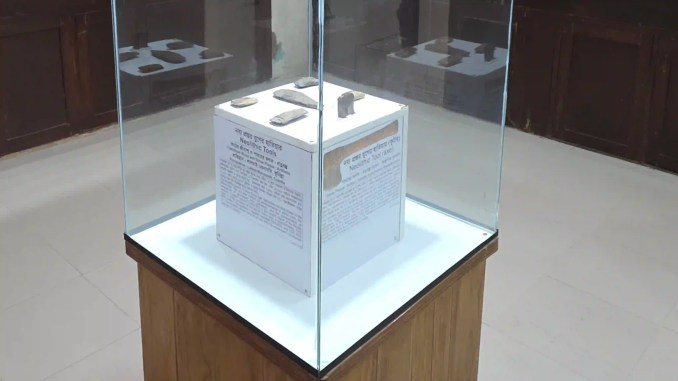
Stone Tools Preserved at Mainamati Museum
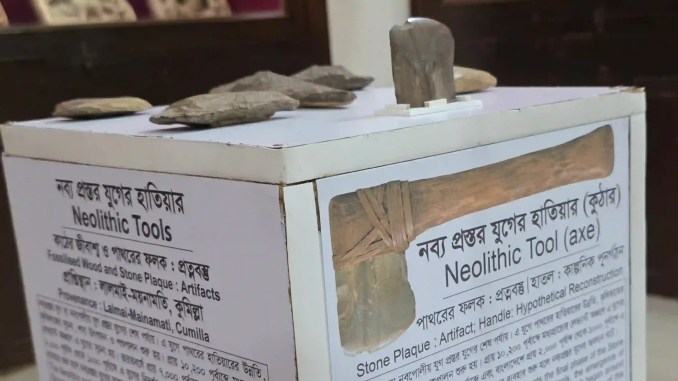
The fossilised wood tools preserved at Mainamati Museum resemble axes and chisels. They generally have a narrow, sharp working end and a broader opposite end, while traces of the wood grain remain visible on their surfaces. These artefacts demonstrate that prehistoric people were familiar with the characteristics of locally available materials and knew how to utilise them for practical purposes.
The museum does not provide a specific chronological date for these tools. Professor Muzammel Haque has suggested that Neolithic people existed in the Chattogram region around 3500–4000 BCE (?). This, however, represents an individual researcher’s regional interpretation. It should not be considered the definitive date or cultural attribution of every tool preserved at Mainamati Museum.
At most, it may be discussed that these artefacts could potentially date to a broad period around 4000–1000 BCE (?), although this requires further scientific verification. Even if this estimated chronology is correct, it would still be considerably later than the emergence of Neolithic cultures in the Levant and at Mehrgarh.
Cultural Significance of Lalmai-Mainamati
Lalmai-Mainamati, which is included on UNESCO’s Tentative List of World Heritage Sites, formed part of the ancient region of Samatata. Samatata is generally regarded as a historical and cultural region that flourished between the fourth and twelfth centuries CE. The region is particularly renowned for its heritage of Buddhist monasteries, temples, and stupas.
However, the prehistoric tools discovered here remind us that human presence in this landscape may extend much further back in time. Nevertheless, these tools alone do not provide sufficient evidence to conclude that fully developed, permanent agricultural settlements existed here during the Neolithic period.
According to Banglapedia, due to the lack of stratified evidence of Neolithic culture in Bengal, the Chalcolithic agricultural cultures of West Bengal and neighbouring regions may be regarded as the earliest known agricultural societies in this part of the region.
The End of the Neolithic Age
The period following the Neolithic Age is known as the Chalcolithic Age or Copper-Stone Age, when copper began to be used alongside stone tools. Later, bronze and other metals brought further changes to technology and production systems. This transition did not occur simultaneously in all regions. In some areas, metalworking emerged long after agricultural societies had become established, while in others, different technologies continued to coexist.
Conclusion
The prehistoric history of Bangladesh remains an open field of archaeological research. The fossilised wood tools discovered in the Lalmai Hills and preserved and displayed at Mainamati Museum provide valuable, though fragmented, insights into the lifestyles and technological practices of prehistoric humans.
Scientific dating of these artefacts, their proper preservation, and more systematic archaeological investigations and researchs could significantly enhance our understanding of the ancient human past of this region.
References :
- Borrell, F., Junno, A., & Barceló, J. A. (2015). Synchronous environmental and cultural change in the emergence of agricultural economies 10,000 years ago in the Levant. PLOS ONE.
- EPFL GraphSearch. (n.d.). Neolithic Revolution: ASPRO chronology and Natufian culture.
- Gopher, A. (n.d.). Breaking Ground: Plant Domestication in the Neolithic Levant. Tel Aviv University.
- Mehrgarh. (n.d.). Wikipedia.
- Jarrige, J.-F. (n.d.). Mehrgarh. eHRAF Archaeology, Yale University.
- RAU’s IAS. (n.d.). Neolithic Age. Compass by RAU’s IAS.
- Banglapedia. (n.d.). Lalmai. Asiatic Society of Bangladesh.
- Banglapedia. (n.d.). Agricultural Communities, Early Period. Asiatic Society of Bangladesh.
- The Daily Star. (2010). JU student discovers prehistoric archaeological signs in Chittagong.
- Siddiq, A. B. (2020). Bangladesh: A potential prehistoric corridor between South and Southeast Asia. 1st CenRaPS Conference Abstracts.
-
UNESCO World Heritage Centre. (n.d.). Archaeological sites of Lalmai-Mainamati. Tentative Lists.
✍️ Author : Md Shahin Alam
Follow Us on Our YouTube channel : GEONATCUL
Grateful to Mainamati Museum, Department of Archaeology, Bangladesh.